Digital-asset regulation
Two Rulebooks, One Dollar
Europe has an operating stablecoin regime. The United States has enacted one and is still completing the rules.
The regimes share a prudential floor: protected reserves, redemption and limits on issuer-paid yield. Their issuer models, scale controls and monetary-policy aims remain different.
The comparison starts with timing
MiCAR can be assessed as a live operating framework. Its stablecoin titles have applied since 30 June 2024, and European issuers and CASPs already work within its authorisation, reserve, disclosure and redemption rules.1
The GENIUS Act became United States law on 18 July 2025. On 22 July 2026, federal agencies were still developing rules on issuance, reserves, licensing, reporting, AML and sanctions. The statute takes effect on the earlier of 18 January 2027 or 120 days after the relevant final regulations.234
This timing difference limits simple scorecards. Europe supplies observed supervisory practice. The United States supplies an enacted architecture whose details are still settling.
| Feature | Micar | Genius Act |
|---|---|---|
| Status on 22 Jul 2026 | Operational since 30 Jun 2024 | Enacted; implementation rules still in progress |
| Core category | EMTs and ARTs | Payment stablecoins |
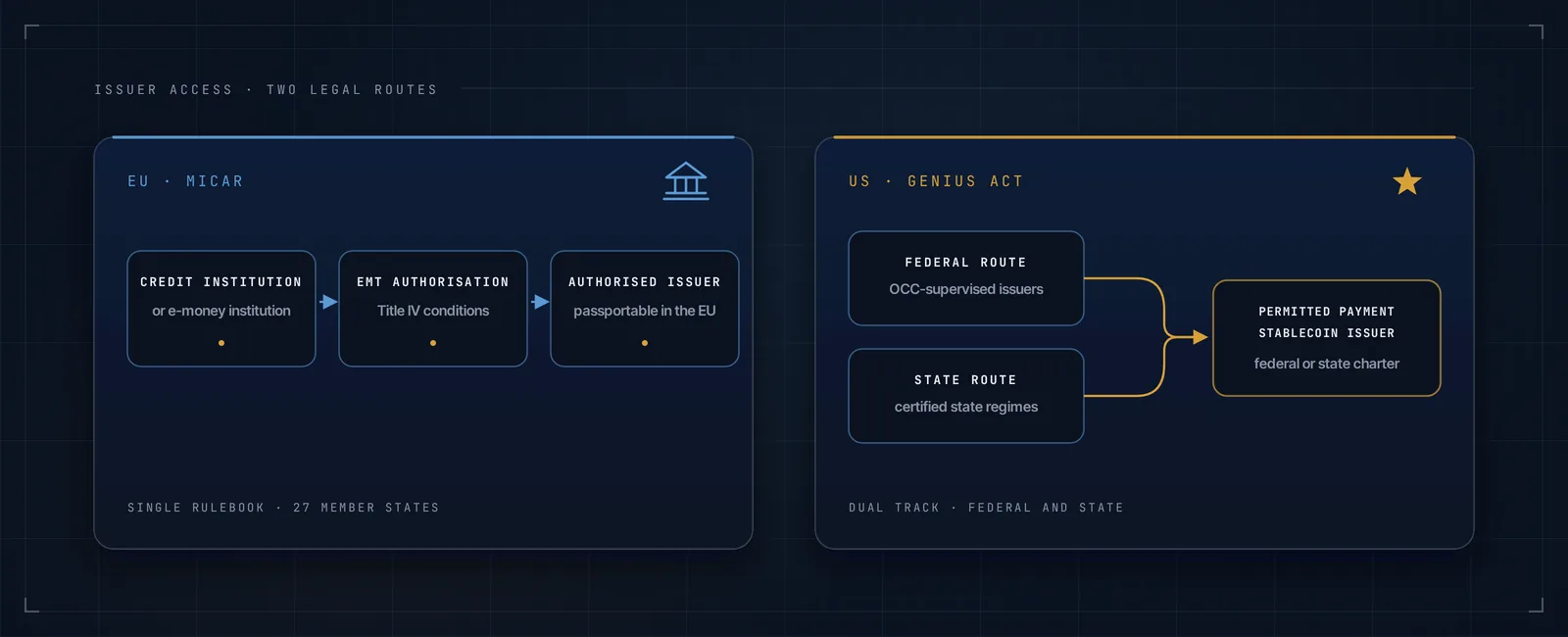
| Issuer route | Bank or EMI for EMTs; authorised ART issuer or bank | Depository subsidiary, federal qualified issuer or qualifying State issuer |
| Reserve design | EMT safeguarding; segregated ART reserve | At least 1:1 enumerated liquid reserves |
| Yield | Interest prohibited for ARTs and EMTs | Issuer-paid yield tied to holding, use or retention prohibited |
| Scale response | Significance regime and means-of-exchange restrictions | State/federal transition above USD 10bn, subject to waiver |
| Foreign route | EU-compliant issuer and token structure | Comparable-jurisdiction finding plus registration and U.S. oversight |
Europe uses two legal categories
An e-money token references one official currency and is treated as electronic money. Only a credit institution or electronic money institution may issue it to the public or seek admission to trading under the MiCAR conditions. The holder has a direct right of redemption against the issuer at any time and at par value.1
Funds received for an EMT are safeguarded through the e-money framework. At least 30% is deposited in separate accounts with credit institutions; the balance is invested in secure, low-risk and highly liquid assets denominated in the referenced currency.5
An asset-referenced token can reference another value, right or combination of values. Its issuer follows a separate authorisation route and maintains a segregated reserve managed against the risks of the reference structure.6
When I review a stablecoin structure, I start with the legal claim before looking at the chain. Who owes redemption, under which law, against which pool of assets? The technical token comes later.
The non-euro restriction is narrower than the headline
Article 23 applies where an asset-referenced token is used widely as a means of exchange in a single currency area and the estimated quarterly average exceeds one million daily transactions and EUR 200 million in daily aggregate value. The issuer must stop issuance and submit a reduction plan within forty working days.7
Articles 22 and 23 also apply to e-money tokens denominated in a currency that is not an official currency of a Member State.8
The calculation concerns qualifying means-of-exchange activity. Trading, investment and settlement activity is not swept into one undifferentiated cap. The EBA technical framework supplies the measurement method for that boundary.9
The policy aim is still visible. Europe accepts regulated dollar tokens while protecting the role of official currencies inside its own currency areas.
GENIUS licenses a broader issuer set
Once the relevant provisions apply, issuance in the United States is restricted to permitted payment stablecoin issuers. The category includes subsidiaries of insured depository institutions or credit unions, federal qualified issuers and State qualified issuers operating under a substantially similar regime.2
The reserve must cover outstanding tokens at least one-to-one and consist of specified liquid assets such as U.S. currency, demand deposits, short-dated Treasuries, qualifying repo arrangements and approved government money-market funds. Reuse is restricted. Monthly reserve disclosure and a public redemption policy are required.2
A State issuer can remain on the State route up to USD 10 billion of consolidated outstanding issuance, subject to the substantially similar determination. Above that level, the statute generally moves the issuer into joint or federal supervision unless a waiver is granted.13
The public-company restriction is also qualified. A non-financial public company faces a high approval gate involving the Stablecoin Certification Review Committee and data-use conditions; the statute does not impose an absolute ban.2
Yield moves to a different instrument
MiCAR prohibits issuers and relevant CASPs from granting interest on ARTs and EMTs. Benefits linked to the length of time a holder keeps the token are treated as interest.1
GENIUS bars a permitted or qualifying foreign issuer from paying interest or yield solely in connection with holding, using or retaining a payment stablecoin.2
The boundary leaves room for separate commercial rewards and separately regulated investment products, subject to their own facts. It also explains why tokenised Treasury funds have become important. Demand for on-chain return survives; the legal instrument carrying it changes.
Stablecoin with yield. Often a category error.
A transatlantic product is two structures
A firm cannot take one global policy, change the footer and call the result a dual-market stablecoin. The European token may need an EU bank, EMI or authorised ART issuer, while the U.S. token needs a permitted issuer once GENIUS becomes effective.
The same brand and ticker can therefore represent claims against different legal entities. Reserve custody, redemption operations, white papers, disclosure, AML controls and insolvency priority may also differ.
Foreign access under GENIUS depends on a comparable-jurisdiction determination, registration with the Comptroller, U.S. reporting and examination, consent to jurisdiction and the ability to comply with lawful orders.1415 An overseas approval on its own does not create access.
My reading is that groups will eventually favour a common technology layer with legally separate issuance cells. That may be efficient, although it makes clear customer disclosure harder.
“Same ticker. Different issuer, reserve and legal claim.”
The risks the statutes leave behind
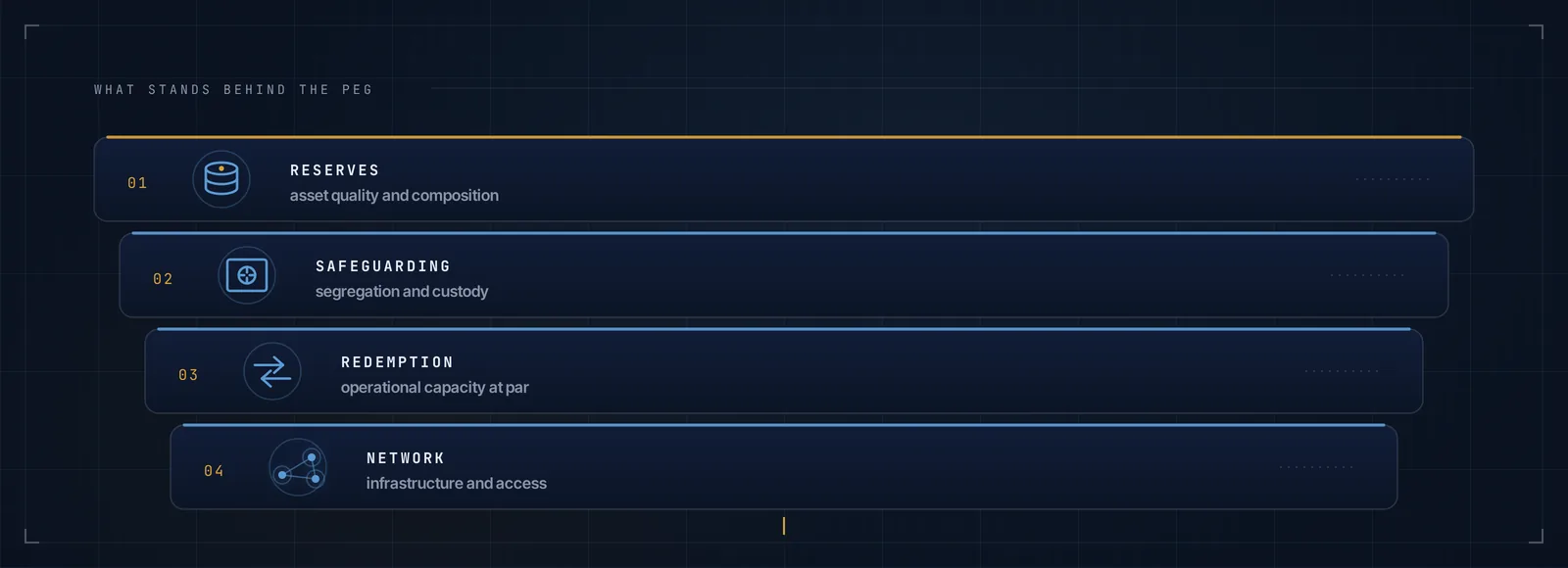
Reserve quality addresses solvency and liquidity risk at the issuer. Redemption can still fail through a banking outage, sanctions review, chain incident or a run that overwhelms operational capacity.
Custodian concentration can spread stress across several tokens. Bridges, wallet providers, smart contracts and exchanges sit outside the reserve pool yet remain essential to use. The issuer may need to freeze addresses or migrate a contract, actions that support compliance while concentrating operational power.
Regulation can also fragment liquidity. A token authorised in one market may be restricted in another, and local issuance entities can divide what appears to be one global pool. Sound issuers help. System resilience requires more.
A dated conclusion
As at 22 July 2026, Europe is testing an operating regime and the United States is completing an enacted one. Both reject the lightly collateralised issuer model that dominated the earlier debate.
The deeper difference concerns strategy. MiCAR integrates private tokens into the existing bank and e-money order, with specific protection against large-scale substitution by non-EU currencies. GENIUS creates a regulated route for dollar payment stablecoins and openly supports wider dollar use.17
Law will influence distribution. Liquidity, integrations and redemption during stress will decide whether users stay.
“INSIGHTS”