Digital-asset regulation
Crypto Marketing in Europe Is Evidence Work
MiCAR permits persuasion. It also makes material claims, publication steps and responsibility traceable.

A compliant campaign begins before the copy. The firm has to identify the asset, the responsible entity, the legal provision and the evidence supporting each material claim.
Begin with the claim file
Consider a social post that says: “Buy TOKEN now - 40% returns. Limited time.” The weakness is visible before a lawyer reaches the footer. The return has no period, basis or source; the urgency may be artificial; the risks and responsible entity are absent; and the reader cannot tell which disclosure document governs the offer.
The better control starts with a claim file. Each statement that could influence a purchase decision is linked to a dated source, an owner and any qualification that must remain beside it. The source may be the white paper, audited data, product terms or an approved calculation. A link alone is not enough when the headline creates the wrong impression.
In campaigns I review, the most common break occurs during translation from technical or legal material into sales copy. “Planned” becomes “available”. A variable reward becomes a clean annual percentage. A liquidity condition disappears. Small edits. Large legal effect.
Four legal lanes
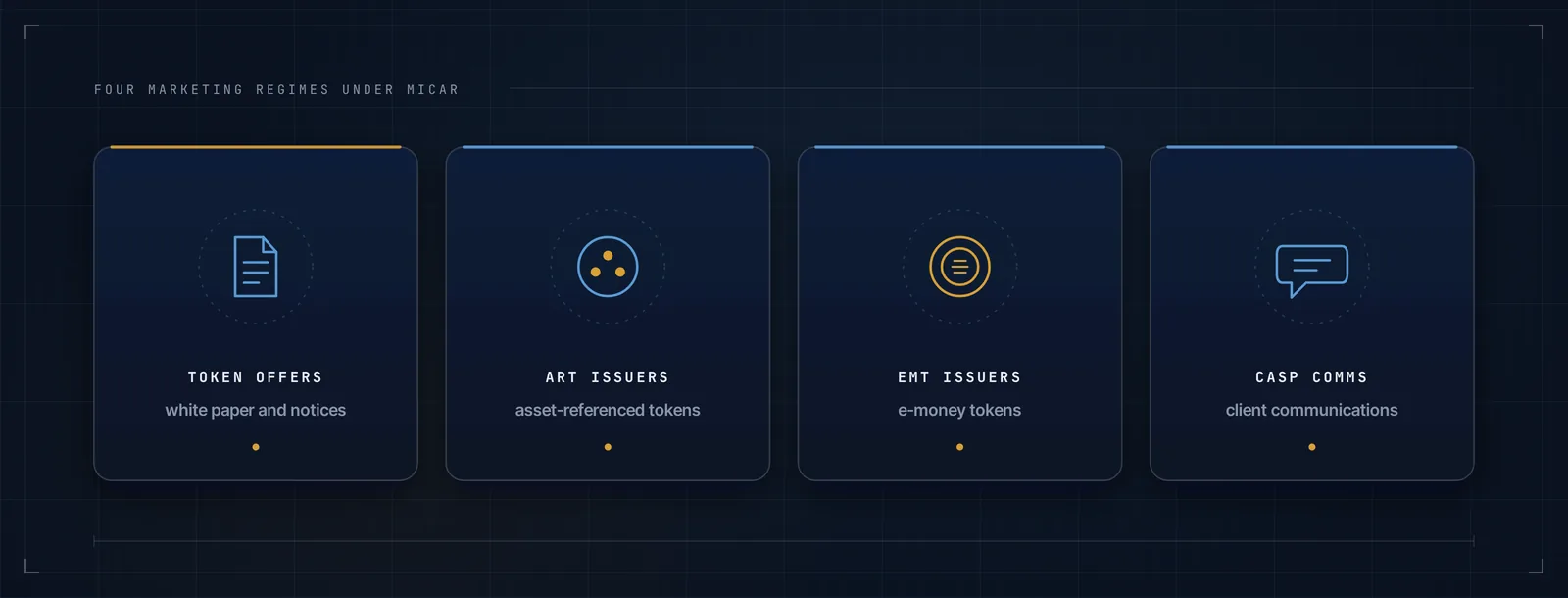
Article 7 governs marketing connected with offers or admission to trading of crypto-assets other than asset-referenced tokens and e-money tokens. Article 29 covers asset-referenced tokens. Article 53 covers e-money tokens. Article 66 applies to information, including marketing communications, that a CASP addresses to clients or prospective clients.1234
A single customer path can engage more than one lane. The issuer may promote a token under Article 7 while an exchange promotes the service through which it can be bought under Article 66. The responsibility statements, white-paper references and redemption language then belong to different regulated actors.
A generic “MiCA compliant” disclaimer cannot solve that allocation. The campaign needs a legal entity, product and service map before the creative is approved.
The white paper sets the outer edge
For a Title II offer, the marketing communication must be identifiable as marketing, fair, clear and not misleading, and consistent with the white paper where one is required. It must include the prescribed statement that no EU competent authority has reviewed or approved the communication, identify the responsible person, state that the white paper has been published and provide the relevant website and contact details.15
Marketing cannot be disseminated before the required white paper is published, apart from the limited room for market soundings. The published campaign should match the version notified to the authority, and material changes need to follow the modification process.6
Consistency does not require an advertisement to reproduce the white paper. It prevents the advertisement from becoming more certain, more liquid or less risky than the document on which the offer rests. My reading is that this will be the central supervisory test because it lets an authority compare two records prepared by the same business.
Stablecoin copy needs product-specific information
Asset-referenced-token and e-money-token communications follow the same general standard, with issuer-specific publication duties. An e-money-token communication must also state clearly that holders have a right of redemption against the issuer at any time and at par value.23
That statement belongs near the commercial message with enough prominence to be understood. Vague language about liquidity or stability is not an equivalent.
The EU issuer matters. A global brand page cannot blur which regulated entity issued the token, holds the redemption obligation and published the white paper.
Influencers, affiliates and personal accounts
Commercial content does not become independent opinion because a creator delivers it in their own voice. Payment, free access, referral income or token compensation places the relationship within consumer-protection disclosure rules, and the underlying claims still have to satisfy the relevant MiCAR standard.1112
The contract should give the firm approval and takedown rights, identify prohibited claims, require disclosure and preserve the final content. Monitoring matters because the published version may differ from the script.
Founders and senior executives also create risk on personal accounts. Context decides whether a post is promotional. A biography saying “views are my own” carries little weight where the person announces a token sale, links to the purchase page and speaks with the authority of the issuer.
No pre-clearance, full accountability
MiCAR generally prevents competent authorities from requiring marketing communications to be approved before publication. That allocation puts the decision with the firm.
Authorities can examine the communication afterwards and use their powers to require amendment, suspend or prohibit marketing, stop an offer and order corrective action.17 A campaign may therefore be lawful to publish without being safe from review.
The absence of a regulatory stamp also matters internally. Marketing, legal and compliance cannot pass responsibility around after release. The approval record should show who accepted the evidence, wording, audience and timing.
“A campaign is publishable when the firm can reconstruct why each material claim was approved.”
The campaign file
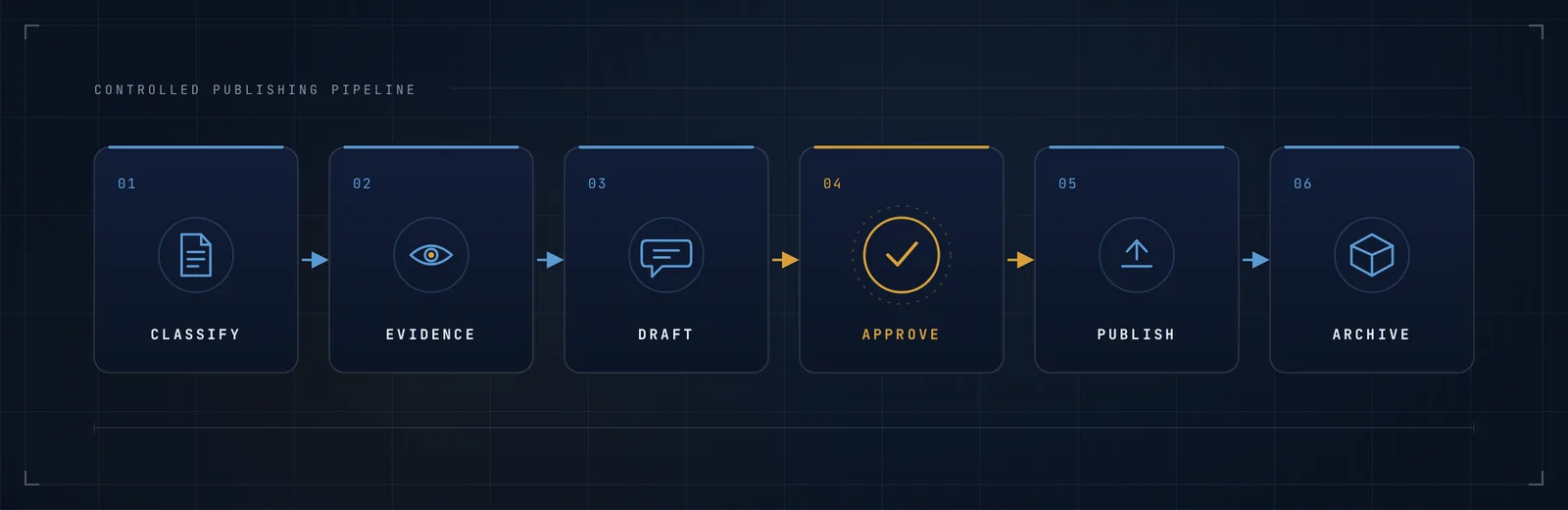
A practical control process has six parts. It can be short for a low-risk post and much deeper for a public token offer, but the sequence remains recognisable.
| 1 | Classify Record the asset, service, responsible legal entity, audience and jurisdictions. |
|---|---|
| 2 | Source Link each material claim to the white paper, product terms or approved evidence. |
| 3 | Draft Apply the required statements and check the overall impression, including prominence. |
| 4 | Approve Name the business, legal and compliance owners and preserve their decision. |
| 5 | Publish Use the approved version across channels, affiliates and translations. |
| 6 | Archive Retain the creative, audience, dates, evidence, approvals, later edits and takedowns. |
Rewrite the advertisement
The original line promised a 40% return and manufactured urgency. A defensible version would identify itself as marketing, describe the token's function in terms consistent with the current white paper, state the responsible entity and carry the required MiCAR information.
If performance information is used, it needs a date, source, period, method and limitations. Risks that alter the meaning of the figure should appear beside it, not at the end of a long page. The call to action can invite the reader to review the offer; it should not pretend that a legal deadline exists when it does not.
The new version may sound quieter. In a regulated market, quiet copy backed by evidence can be more commercially useful than a headline that a bank, supervisor or counterparty would not accept.
“INSIGHTS”